Why More Students Are Choosing Skill-Based Degrees Over Traditional Courses
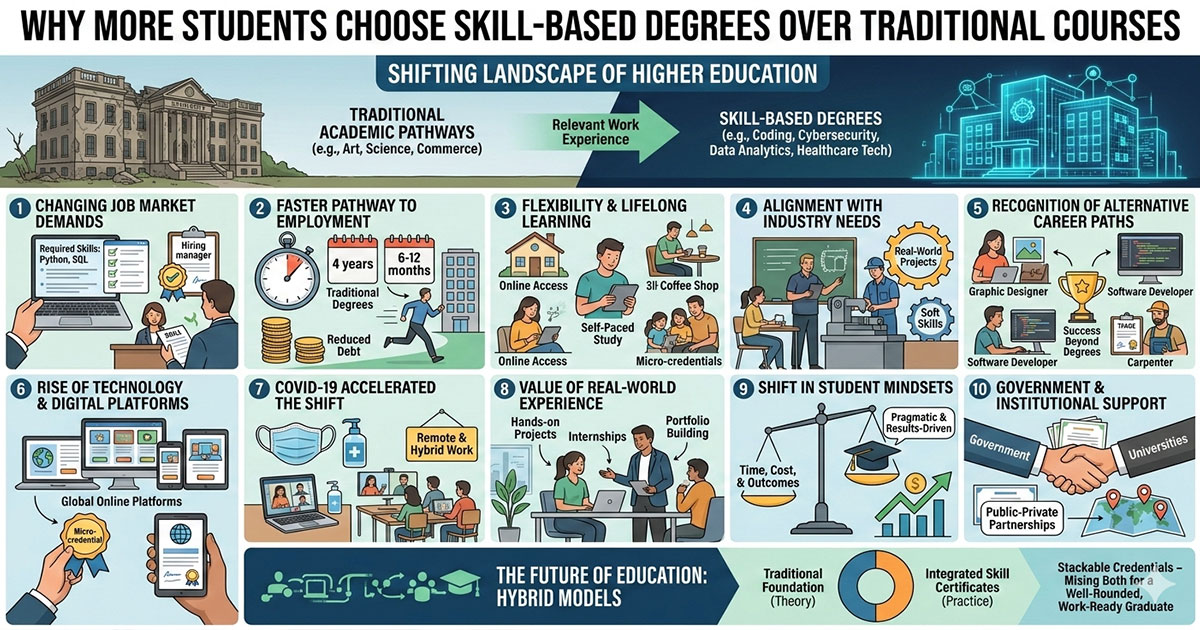
Recent years have witnessed a dramatic change in the way students perceive higher education; traditional academic pathways (art, science, commerce) are slowly giving way to skills-focused degrees (with practical skills/competencies) as more people pursue an education that will provide them with relevant work experience. Changes in the job market, learner expectations, and social attitudes are the key influences behind these shifts. We will examine the major reasons for the change and how these changes affect students, educators, and employers.
Graduates are increasingly judged by what they can do, rather than where they obtained their degree in the 21st century. A growing number of sectors, particularly technology, healthcare, digital media and the skilled trades, now evaluate applicants on the basis of concrete abilities rather than educational credentials. For instance, many coding bootcamps teach their enrollees to develop actual coding skills, or Digital marketing courses emphasizing using specific tools to execute an effective SEO and content strategy with analytics. Students enrolled in cybersecurity programs learn how to develop hands-on defensive skills that employers actively seek.
Consequently, many students have come to see developing particular skills, such as data analytics, programming or advanced digital literacy, as a much more direct route to being employed than through completing courses with a theoretical focus.
Step into a future full of possibilities with Chandigarh University!
Traditional degrees use take 3-4 years (or longer in some countries). Skill-based programs on the other hand, whether certificates, diplomas or accelerated degrees, can take be done in weeks or months. This allows students to enter the workforce sooner and reduce long-term educational costs. In an era where student debt is a global concern, shorter programs with clear career pathways are attractive.
3. Flexibility and Lifelong Learning
Traditional degrees usually are not as flexible and follow a rigid curricula. Skill-based education on the other hand offers flexibility, modular design that enables a learner to learn one skill at a time. Apart from it, online access to courses is available from anywhere, which can also enable self-paced study practices and help a student balance work, family, and education. This structure supports lifelong learning, enabling workers to continually update skills in a fast-changing job market.
4. Alignment With Industry Needs
Many skill-based programs are developed in partnership with employers. Companies help design curriculum, which includes tools and technologies currently used in the field, real world project experience, soft skills like teamwork, communication, problem solving and much more. This alignment reduces the gap between education and workplace expectations, which traditional degrees often fail to bridge.
5. Recognition of Alternative Career Paths
Not all valuable careers require university degrees. Trades, creative industries and tech roles often reward talent, portfolio quality and certified skills. For example, Graphic designers can succeed through strong creative portfolios, or Software developers may be hired based on coding tests, and Digital creators can build audiences and monetize directly, etc. As alternative career paths expand, so does the idea that traditional degrees are the only route to success.
6. Rise of Technology and Digital Platforms
The growth of online learning platforms — Coursera, edX, Udemy, LinkedIn Learning, and others — has democratized education. These platforms offer courses from global universities and industry experts, provide micro-credentials linked to specific skills and are often accessible at low cost. This access allows students from different regions and economic backgrounds to pursue focused education without relocating or paying high tuition fees.
7. COVID-19 Accelerated the Shift
The pandemic disrupted traditional classroom learning and forced many institutions online. Students and educators alike realized that remote, flexible learning works while employers adapted to assessing digital portfolios and online testing and workplaces embraced remote and hybrid jobs. All of this made distance-friendly, skill-focused models more acceptable and desirable.
8. Value of Real-World Experience
Skill-based programs often integrate hands-on projects, internships, practicum experiencesand industry collaborations. This practical exposure gives students real work samples,experience with professional tools,confidence in job settings. Employers often value these real-world experiences mo re than academic theory.
9. Shift in Student Mindsets
With modern-day students being more career-oriented, results-driven, they are usually pragmatic about education ROI. Many students weigh the cost, time and outcomes of a degree more sharply than previous generations. They want education that clearly leads to jobs, income or entrepreneurial opportunities.
10. Government and Institutional Support
In many countries, governments and universities are recognizing the importance of skill-based education. They are launching skill certification programs, university courses with industry accreditation, public-private partnerships to train in-demand skills and much more. This institutional support is reducing barriers and increasing acceptance of non-traditional credentials.
The Future of Education? Hybrid Models
Instead of completely replacing traditional degrees, we will probably see integration where the former will have built in skill certificates. Furthermore, the mode of assessments should move towards analysing skills instead of tests. Also the curriculum should inculcate stackable credentials that mix theory and practice to give students both a deep understanding of theory and the skills they need to work in the real world.
Conclusion:
The emergence of skill-based degrees is a result of a shift in the way students perceive education and their careers. The changing nature of the job market, technology, costs and demands for relevance have led to students making informed decisions. Skill-based learning, with its emphasis on true skills, flexibility and relevance to industry requirements, is more than a trend; it is a major shift in the education paradigm.
Step into a future full of possibilities with Chandigarh University!
B.Com Llb Vs Ba Llb Which Course Is Better After 12th
Explore key details about B.Com Llb Vs Ba Llb Which Course Is Better After 12th, including important information, opportunities, and insights for students.