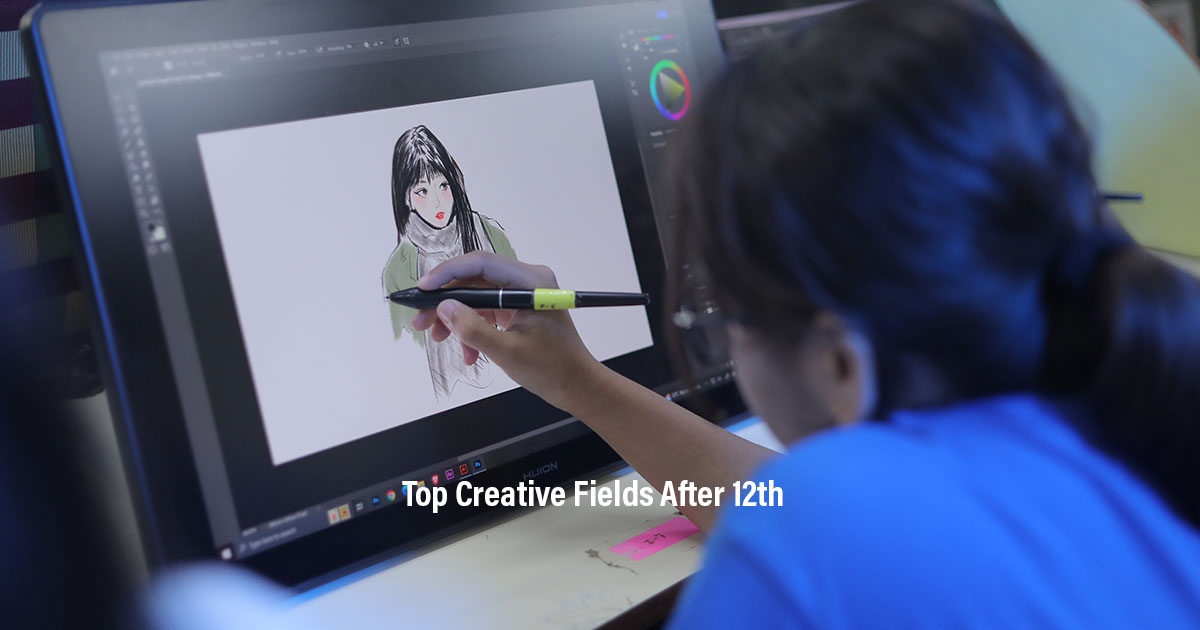
Creative fields after 12th are no longer a backup plan. India's media and entertainment industry hit ₹2.78 trillion in 2025, growing 9% in a single year, and needs trained designers, animators, journalists, and storytellers to keep up. If you're good with ideas and want real career options, here's what actually exists beyond B.A. Fine Arts.
India's M&E sector grew 9% in 2025 to ₹2.78 trillion and is on track to hit ₹3.3 trillion by 2028
India's Animation & VFX sector alone is projected to reach USD 2.2 billion by 2026, up from USD 1.3 billion in 2023
The AVGC sector is expected to create over 1.6 lakh new jobs every year, totaling 20 lakh jobs by 2030
India's Union Budget 2026–27 backed AVGC creator labs in 15,000 schools and 500 colleges.
Chandigarh University's journalism graduates start at ₹5–7 LPA, with top design placements reaching 6 LPA
Creative career options after 12th now include Design, Fine Arts, Journalism, Animation, VFX, and Game Design, with structured degree programs for each
What Are Creative Courses After 12th?
Creative courses after 12th are programs that train you in design, media, communication, storytelling, animation, and visual arts. They are not "soft" options. They are technical, skill-heavy, and increasingly in demand.
Here's the thing: every app you use, every ad you scroll past, every OTT show you binge, and every brand logo you recognize was made by someone with a creative education. That someone could be you.
According to the FICCI-EY Media & Entertainment Report 2026, India's M&E sector supports 2.75 million direct jobs and over 10 million indirect employment opportunities. And that number is climbing every year.
So no, "creative" is not a risky bet. It's one of the fastest-growing job markets in India right now.
Why Creative Fields After 12th Are Worth Considering in 2026
A lot of students (and parents) still think engineering or commerce are the only safe routes. But the numbers tell a different story.
According to the FICCI-EY Report 2026, India's media and entertainment industry grew 9% in 2025 to reach ₹2.78 trillion, outpacing the country's GDP per capita growth of 7.7%.
That's not a small industry. That's a sector that needs writers, designers, animators, filmmakers, journalists, and UX professionals.
And it's not just media. The India Briefing report on India's Orange Economy (February 2026) notes that the Union Budget 2026–27 specifically prioritizes India's creative economy, covering media, animation, VFX, gaming, design, live events, and cultural services, as a long-term growth engine.
Creative fields after 12th are backed by real policy, real funding, and real jobs. Here's what those fields look like in practice.
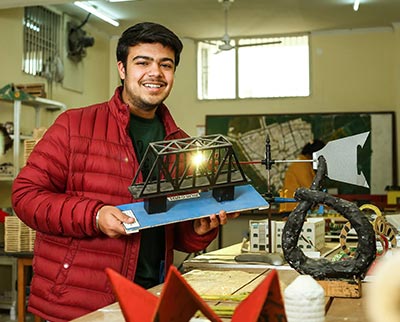
Design is one of the most practical creative career options after 12th. It combines problem-solving with aesthetics, and it shows up everywhere, from the chair you sit on to the app you're reading this on.
If you want to work professionally in the visual arts, not just as a hobby, a BFA is the right path. It is not the same as a B.A. Fine Arts. BFA programs go deeper into studio practice, contemporary art, and commercial applications.
At CU's UID, BFA students work across drawing, painting, sculpture, photography, digital art, video, and installation, so you graduate with a full range of skills, not just one medium.
Key program highlights:
Faculty with international and post-doctoral research backgrounds
Access to studios: Clay Modeling Studio, Digital Rendering Studio, Prototyping Studio, Workspace Studio
Hands-on internships and industry visits with organizations like BrandoMax, Studio Hash, and CineRig Studios
Highest placement package offered: 6 LPA
BFA is a solid choice for students who want to work in brand identity, illustration, art direction, or gallery spaces, and who want a structured education to get there.
3. BA in Journalism & Mass Communication (JMC)
If you like asking questions, telling stories, or understanding how the world works, journalism and mass communication are worth a serious look. It is one of the most versatile courses after 12th in creative fields, because it opens doors across media, PR, advertising, content, and digital platforms.
India's M&E sector now supports digital advertising revenues of ₹94,700 crore, a 26% increase in a single year. All of that content needs writers, producers, and strategists.
At Chandigarh University, the University Institute of Media Studies (UIMS) offers BA, MA, and PhD in JMC. The institute has been ranked 16th by Outlook and in the Top 25 by India Today among journalism institutes in India.
What students actually do here:
Produce live shows on the Global Campus Hub digital channel
Write and design the monthly magazine Saptsindhu and newsletter Campus Connect
Get hands-on training at Radio Punjab 90.0 FM, CU's community radio station
Work inside a professional TV studio with a fully operational Production Control Room (PCR), covering everything from shooting to live news anchoring
Attend international programs like the Walt Disney World Cultural Exchange (USA) and the Digital Marketing Program at Heriot-Watt University, Dubai
Placement partners include: Radio Mirchi, ABP Sanjha, The Ideaz Factory, Praper Media, Connect FM Canada, and White Hill Studio. Starting packages: ₹5–7 LPA.
4. Bachelor's in Animation, VFX & Gaming
This is one of the fastest-growing creative career options after 12th in India right now. The numbers back it up clearly.
According to a CII GT report cited by IBEF, India's Animation and VFX sector is projected to grow from USD 1.3 billion in 2023 to USD 2.2 billion by 2026, and the broader AVGC sector is expected to generate over 1.6 lakh new jobs annually, reaching 20 lakh total jobs by 2030.
And the Union Budget 2026–27 went further, it announced AVGC creator labs in 15,000 secondary schools and 500 colleges across India, recognizing animation, VFX, gaming, and comics as a national priority (Best Media Info, February 2026).
India's gaming market is currently valued at $3.7–4 billion, supported by 400–500 million gamers. It is projected to reach $9–10 billion by 2029.
The curriculum is benchmarked against top international schools, including Vancouver Film School, Ringling College of Art and Design, and Gnomon School of Visual Effects, Games & Animation.
Students regularly interact with working industry professionals. Recent guest sessions included 3D expert BN Vichar and Ms. Jayanti Mahapatra from FOLKS VFX.
Top recruiters include: Prime Focus World Division (Mohali), Intelligaia Technologies/Digitoonz (Noida), Spring News Corporation (Bangkok), Bonker's Art. Average package: ₹3–5 LPA.
Is a Creative Degree Actually Worth It?
Honest answer: It depends on where you study and how seriously you treat the work.
A creative degree from a place that gives you real tools, actual industry exposure, and working studio space is worth it. One that only gives you theory and a certificate is not.
So before picking any program, ask these questions:
Do students work on real projects with real clients?
Are there proper studios, labs, and production facilities?
What do graduates actually earn in their first year?
Does the faculty have industry experience, not just academic qualifications?
Are there international opportunities built into the program?
These are the questions Chandigarh University's design, arts, media, and animation programs can answer directly through placement records, live student work, and active industry collaborations.
Courses After 12th in Creative Fields: A Quick Comparison
Program
Duration
Starting Salary
Top Recruiters
B.Sc. Interior / Fashion / B.Des. Product Design
3–4 years
₹3.5 LPA
Reliance Retail, Arvind Fashions, Tommy Hilfiger
Bachelor of Fine Arts (BFA)
4 years
Up to ₹6 LPA
BrandoMax, CineRig Studios, Studio Hash
BA Journalism & Mass Communication
3 years
₹5–7 LPA
Radio Mirchi, ABP Sanjha, Connect FM Canada
Bachelor in Animation, VFX & Gaming
3–4 years
₹3–5 LPA
Prime Focus World, Digitoonz, Bonker's Art
Frequently Asked Questions
Which creative field after 12th has the best salary?
Journalism & Mass Communication has the highest starting range among the options listed here; CU graduates start at ₹5–7 LPA. BFA placements have hit up to ₹6 LPA. But salary also depends on the city you work in, the company, and the strength of your portfolio. A good portfolio often matters more than the specific degree.
Can I pursue creative courses after 12th without a science or commerce background?
Yes. Most creative courses after 12th, including Design, BFA, JMC, and Animation, accept students from any stream: Arts, Commerce, or Science. Admission is usually based on an entrance test, portfolio, or both. Your 12th stream is rarely a barrier.
Is a BFA better than a BA in Fine Arts?
They are different programs, not interchangeable. BFA (Bachelor of Fine Arts) is a professional degree focused on studio practice, with more hours in actual making, drawing, painting, digital art, sculpture, and so on. BA Fine Arts tends to be more theory-heavy. If you want to work as an artist or creative professional, BFA is the stronger choice.
How long does it take to complete these courses?
Most undergraduate creative programs last 3 to 4 years. Design (B.Des.) is typically a 4-year program, though CU's programs offer an exit option after 3 years. BFA is 4 years. The BA JMC and Animation programs are generally 3 years in length. Postgraduate options (MA, M.Des.) add another 2 years if you want to specialize further.
Do creative career options after 12th lead to stable jobs or mostly freelance work?
Both are realistic outcomes, and that's actually a good thing. Design, animation, and JMC graduates work in full-time roles at agencies, studios, media houses, and brands. Many also freelance, especially in animation, illustration, and content creation, once they build a portfolio. The creative economy increasingly supports both paths.
Is animation a good career in India in 2026?
Yes, and the data supports it. According to a CII GT report cited by IBEF, India's Animation and VFX sector is set to reach USD 2.2 billion by 2026. The Union Budget 2026–27 also backed AVGC creator labs in 15,000 schools and 500 colleges, which signals serious long-term investment in the field. Demand for animators, VFX artists, and game designers is only going up.
Step into a future full of possibilities with Chandigarh University!
B.Com Llb Vs Ba Llb Which Course Is Better After 12th
Explore key details about B.Com Llb Vs Ba Llb Which Course Is Better After 12th, including important information, opportunities, and insights for students.