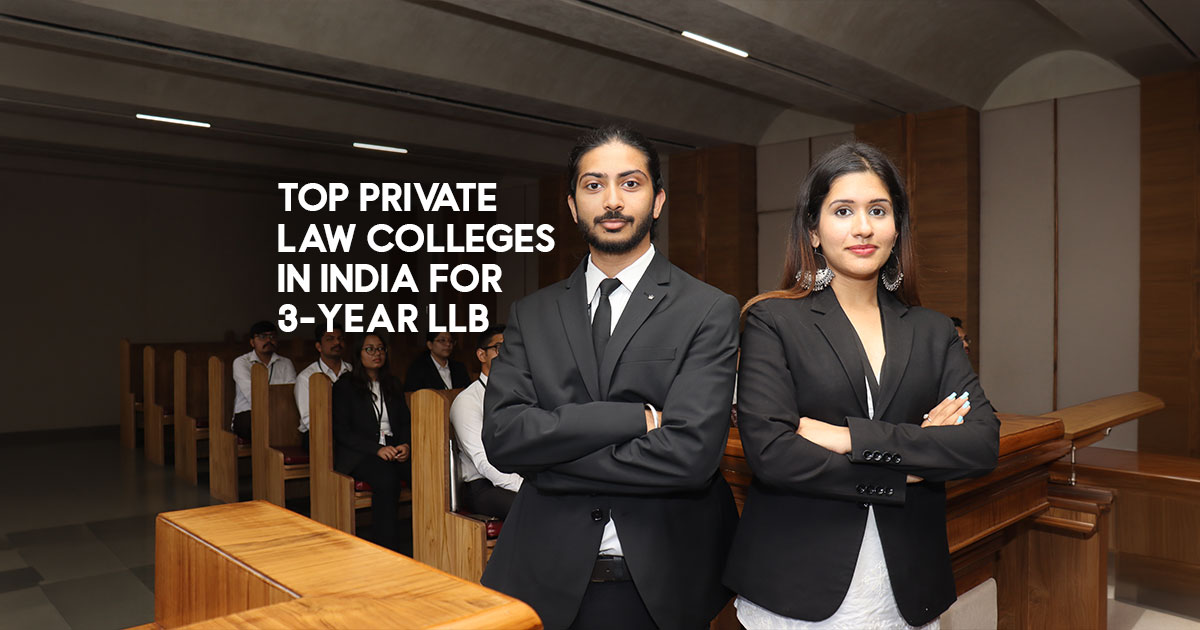
Since ancient times, Law has been the backbone of every progressive society, from ensuring justice to governance and order. Similarly, the legal profession has always held a unique place in shaping societies across the world. The scope for professionals equipped with legal acumen in the present day world has expanded dramatically. A degree in law serves as a gateway to countless career opportunities, whether its corporate boardrooms, courtrooms or public service commissions or academia.
Choosing what law degree to pursue for a thriving career is as important as choosing the right college for it since a law degree is a gateway to diverse, impactful and often prestigious careers. A 3-year LLB in India can offer a wide range of career tracks as it combines your previous academic or industry background with legal training.
What is the professional scope for 3-Year LLB Graduates?
The National Institutional Ranking Framework (NIRF) and institutional data for top-tier law schools show that domestic median packages sit between ₹16 LPA and ₹20 LPA. 3-Year LLB graduates have a plethora of professional opportunities, ranging from structured pre-placement offers (PPOs) by elite corporate law firms to Public Governance & Advisory roles to judicial services. Here's a breakdown of major career paths:
Legal Practice and Litigation - Litigator (District & Sessions Courts), Defense Counsel (Criminal Prosecution Defense), Family Court Lawyer, etc.
Judicial Services - Civil Judge (Junior Division) / Judicial Magistrate (State Judicial Services), Public Prosecutor / Assistant Public Prosecutor (APP) and more.
Corporate Law - In-House Legal Counsel / Corporate Legal Advisor, Corporate Law Firm Associate, Compliance Officer / Company Secretary Associate, Contract Management Specialist, etc,
Legal Process Outsourcing (LPO) - Legal Research Analyst, Compliance Review Specialist (For overseas regulations like GDPR/HIPAA) and more.
Civil Services - IAS / IPS / IFS Officer (UPSC CSE route leveraging Law as an optional subject), Law Officer / Legal Advisor (In ministries and government departments) and more.
Academia and Research - Assistant Professor of Law (Requires LLM + clearing UGC-NET), Socio-Legal Researcher (For NGOs and human rights organizations), etc.
International Law and Diplomacy - Human Rights Officer / Legal Analyst (UN agencies, Amnesty, Human Rights Watch), Diplomat / Foreign Service Officer (Ministry of External Affairs) and more
Intellectual Property Rights (IPR) - Patent Attorney / Patent Agent (Highly sought after if your graduation is in B. Sc/B. Tech), Trademark and Copyright Lawyer, Brand Protection Specialist and more.
Media and Entertainment Law - Media Legal Counsel (For OTT platforms, production houses, and record labels), Sports Lawyer / Player Agent (Handling athlete contracts and sporting league compliance), Censorship and Broadcast Compliance Officer, etc.
Legal Journalism - Legal Editor / Columnist (For mainstream media houses and digital publications), Legal Content Curator / Script Advisor, etc
What are the top private law colleges in India for 3-year LLB?
The top private law colleges in India for 3-year LLB include:
Siksha 'O' Anusandhan (SOA) University
Symbiosis Law School, Pune, Maharashtra
University Institute of Legal Studies, Chandigarh University
ILS Law College, Pune
KIIT School of Law
What 3-year LLB programs does Chandigarh University offer?
Ranked among India’s top 1% and World’s top 2% universities by QS World Rankings 2026, Chandigarh University is NAAC A+ university that offers a diverse range of programs in legal studies through the University Institute of Legal Studies. Accredited by the Bar Council of India (BCI), CU offers the following industry-aligned 3-year LLB programs:
Bachelor of Law (LL.B)
Bachelor of Arts + Bachelor of Law (B.A. LL.B (Hons.)) - Integrated
Bachelor of Commerce + Bachelor of Law (B.Com. LL.B (Hons.)) - Integrated
Bachelor of Business Administration + Bachelor of Law (B.B.A. LL.B (Hons.)) - Integrated
What makes the 3-Year LLB Course at Chandigarh University stand out?
Chandigarh University offers the 3-Year LLB course through the University Institute of Legal Studies, which is approved by the Bar Council of India and is a distinguished centre for legal research & teaching. Following are some of the features of 3-Year LLB course at Chandigarh University:
Experiential Learning: With moot courts, legal aid clinics and internships at reputed firms, the program emphasizes hands-on training.
Global Exposure: Students benefit from international exchange programs, enabling them to learn about legal practices worldwide. CU has 530+ international collaborations in 100+ countries.
Career-Oriented Training: Dedicated sessions for judicial exams and competitive test preparation enhance employability.
Flexible Choice-Based Credit System (FCBCS): Allows students to tailor their learning journey by choosing electives aligned with their interests.
Advanced Credit Programs: Industry-oriented certifications enhance students’ skills and employability.
Industry Interaction: Regular guest lectures, court visits and legal workshops ensure students stay connected to the latest developments in the field.
Why choose Chandigarh University for a 3-Year LLB?
It is a significant decision to choose the right university for your legal education as it can shape your career and future. Chandigarh University’s 3-year LLB programs offer the perfect blend of academic rigor, practical exposure and career opportunities, making it the best choice for aspiring legal professionals. From its industry-oriented curriculum to its state-of-the-art infrastructure, Chandigarh University ensures students are equipped to meet the challenges of a dynamic legal landscape.
1. What is the official eligibility criteria for a 3-year LLB?
Academic Qualification: You must hold a bachelor's degree (10+2+3 or 10+2+4 pattern) in any discipline (Arts, Science, Commerce, Engineering, etc.) from a university recognized by the Bar Council of India (BCI).
Minimum Marks Requirement: The BCI sets the baseline at 45% aggregate marks for the General category, 42% for OBC, and 40% for SC/ST candidates. Note that premier central universities like Delhi University set higher institutional benchmarks (e.g., 50% for General).
Final-Year Status: Students currently completing their final year of graduation are fully eligible to apply provisionally.
2. Is there an upper age limit to pursue a 3-year LLB in India?
No, there is no maximum age limit. Following regulatory clarifications and judicial directives, the BCI enforces no upper age cap for enrolling in a 3-year law program. This makes the degree highly accessible to working professionals, corporate switchers and retired individuals looking to transition into legal practice.
What are the top national entrance exams for the 3-year LLB?
Admissions to reputable institutions are rarely direct; They are routed through competitive entrance tests:
NLSAT: Conducted by NLSIU Bangalore (India's top-ranked law school) for its 3-year LL.B. (Hons.) track.
CUET PG (Law): The entry point for major central universities, most notably Delhi University (Faculty of Law) and Banaras Hindu University (BHU).
MH CET Law (3-Year): The mandatory state-level test required to secure a seat at elite Maharashtra state colleges like GLC Mumbai and ILS Law College, Pune.
LSAT India & SLS AIAT: The primary entrance tools utilized by premier private law schools like Jindal Global Law School and Symbiosis Law School respectively.
4. Can a student from a Science or Engineering background do well in a 3-year LLB?
Yes, and they are highly sought after. While many assume law is strictly for arts or commerce graduates, science and engineering graduates hold a massive professional advantage in Intellectual Property Rights (IPR) and Patent Law. Under Indian regulatory frameworks, only individuals with a science/technical graduation degree who also possess an LLB can clear the Patent Agent Examination to officially practice as a Patent Attorney.
5. Can I practice in court immediately after obtaining my 3-year LLB degree?
No, graduation is the first step. To actively practice as an advocate in Indian courts, you must first complete formal provincial enrollment with your respective State Bar Council. Following state enrollment, you are granted a provisional license and must successfully clear the All India Bar Examination (AIBE) within a two-year window to secure a permanent Certificate of Practice (COP).
Step into a future full of possibilities with Chandigarh University!
B.Com Llb Vs Ba Llb Which Course Is Better After 12th
Explore key details about B.Com Llb Vs Ba Llb Which Course Is Better After 12th, including important information, opportunities, and insights for students.