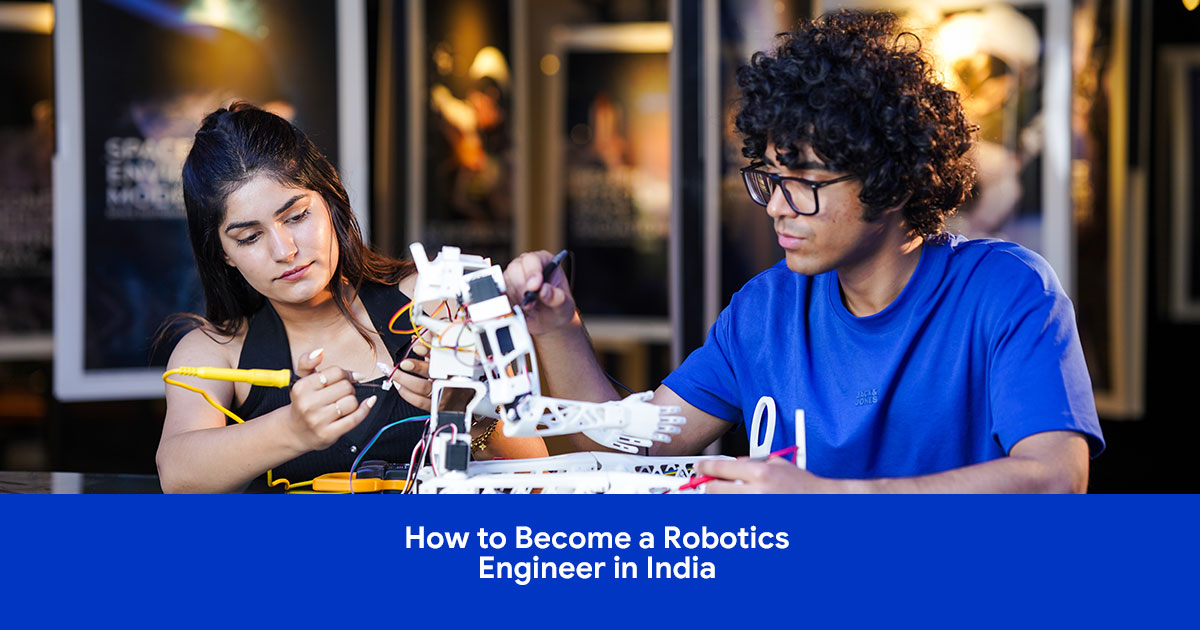
India installed 9,120 industrial robots in 2024 and is the sixth largest in the world, according to the International Federation of Robotics. To become a robotics engineer in India, you need to have a B.E./B.Tech. Tech in Mechanical, Electronics, Mechatronics or Computer Science Engineering then an M.E. in Robotics and AI for higher positions. Core competencies are MATLAB, Python, PLC programming, embedded systems and ROS. Opportunities include automotive, aerospace, defense, logistics and health care sectors.
The scope of robotics and automation engineering in India is massive. The market is expected to grow from USD 1.98 billion in 2025 to USD 7.38 billion by 2034, at a CAGR of 13.1% (Source: IMARC Group, 2025).
Robotics engineering salaries in India range from ₹4 to ₹8 LPA for freshers, rising to ₹20 to ₹40 LPA for senior-level roles in core robotics and AI.
The Government of India's PLI scheme, National Strategy on Robotics, National Mission on Interdisciplinary Cyber-Physical Systems (NM-ICPS), and Make in India 2.0 are all driving direct demand for robotics engineers.
Chandigarh University offers an M.E. in Robotics and AI, with industry partnerships with Texas Instruments and LEGO Mindstorms, and international collaborations with McMaster University (Canada), the University of Birmingham (UK), and the University of Illinois (USA).
CU's M.E. Robotics program attracts 130+ recruiters annually, offers an average package of ₹8 to ₹9 LPA, and has a highest package of ₹40 LPA.
Beginners can start with CU's Introduction to Robotics course, developed in collaboration with Altium, offering free enrollment, dual certification, and hands-on Arduino and PCB design projects.
What Does a Robotics Engineer Do?
Robotics engineers design, build, program and service robotic systems. This can include robotic arms on an automotive assembly line, control software for autonomous drones, surgical robots for hospitals, or cobots for smart factories. It’s a role at the intersection of mechanical engineering, electronics, control systems, AI and software.
Robotics and Automation Engineering Scope in India
The robotics engineering scope in India is exceptional right now.
India ranked sixth globally in industrial robot installations in 2024, according to the International Federation of Robotics World Robotics 2025 Report. The AI in Robotics market is projected to grow from USD 6.11 billion in 2025 to USD 33.39 billion by 2030, according to Markets and Markets. Companies need engineers who understand both hardware and software, and that shortage is your opportunity.
Government Schemes Driving Robotics and Automation Engineering Scope in India
Government policy directly shapes where jobs get created, and several major schemes point toward robotics.
1. National Strategy on Robotics (MeitY, 2023)
Released by the Ministry of Electronics and Information Technology, the Draft National Strategy on Robotics aims to make India a global robotics leader by 2030. It identifies the need to nurture a skilled robotics workforce, promote indigenous IP, and build a domestic manufacturing ecosystem, explicitly under Make in India 2.0, which lists robotics as one of 27 priority sub-sectors.
2. Production Linked Incentive (PLI) Scheme
The PLI scheme, with an outlay of ₹1.91 lakh crore across 14 sectors, provides financial incentives for manufacturers to adopt automation and robotics. As of December 2025, it has attracted investment commitments of ₹2.16 lakh crore and employment for 14.39 lakh people (Source: Press Information Bureau).
3. National Mission on Interdisciplinary Cyber-Physical Systems (NM-ICPS)
The Department of Science and Technology sanctioned ₹170 crore to IIT Delhi to set up the I-HUB Foundation for Cobotics (IHFC), India's Technology Innovation Hub for collaborative robotics. IHFC funds research in healthcare robotics, drone applications, and human-robot interaction, creating funded opportunities for robotics graduates.
4. Make in India 2.0
Robotics is one of 27 priority sub-sectors. The initiative encourages domestic manufacturing of robotic systems, thereby increasing demand for engineers to build and maintain them locally.
5. IndiaAI Mission
The Union Budget 2024-25 has assigned ₹10,371 crore to the IndiaAI Mission to build India’s AI infrastructure and skilling ecosystem. As modern robotics is inseparable from AI and machine learning, professionals at this intersection get benefits directly.
6. Skill India and NSDC Robotics Programs
Students who want to enter the job market but don’t have a full engineering degree can get short-term certifications through NSDC’s affiliated training centres that offer automation, robotics and Industry 4.0 skilling programs.
How to Become a Robotics Engineer: Step by Step
Step 1: Build the Right Foundation in Classes 11 and 12
Take the PCM stream. If your school offers computer science, take it as an elective. Those who have secured 75% or more in PCM are eligible to apply for most of the engineering entrance exams and Direct admission in such colleges like Chandigarh university without CUCET.
Step 2: Choose the Right Undergraduate Program
You can become a robotics engineer through several B.E./B.Tech routes:
B.E./B.Tech in Mechanical Engineering with a focus on automation and mechatronics
B.E./B.Tech in Electronics and Communication Engineering (ECE) for control systems and embedded systems
B.E./B.Tech in Computer Science Engineering with AI/ML specialization for software-heavy robotics roles
B.E./B.Tech in Mechatronics Engineering is the most directly aligned undergraduate path
Choose an institution with industry-connected labs, hands-on projects, and strong placement records.
Step 3: Build Technical Skills During Your Degree
Build these through projects, internships, and certifications. Classroom learning alone does not cover them:
CU's free Introduction to Robotics course in collaboration with Altium is a 1-week, fully online, project-based course offering dual certification from Chandigarh University and Altium. You will build Bluetooth-controlled robots, work with Arduino kits and Tinkercad simulations, and learn PCB design using Altium Designer. Free enrollment is available under CU's Advanced Credit Program.
Step 4: Pursue an M.E. in Robotics and AI for Specialized Roles
If you are serious about how to become a robotics engineer in high-value roles, a postgraduate degree makes a substantial difference. Senior, research, and international positions require it.
Chandigarh University's M.E. in Robotics and AI is among the most comprehensive programs in India in this field. Here is what it covers:
Curriculum: Industry 4.0/5.0 aligned, covering AI, smart manufacturing, cyber-physical systems, automation, IoT, MATLAB, Python, ROS, robot kinematics and dynamics, and image processing.
Industry partnerships:
Texas Instruments: Live workshops, hands-on practice with RSLK robotics kits and TIVA Launchpad
LEGO Mindstorms/National Instruments: Research on EV3 kits, NI ELVIS, NI myRIO, and mechatronics sensor boards
Certifications from Infosys Springboard, Microsoft, Volvo, MG Motor, Coursera, and LinkedIn
International collaborations:
Pathway programs at McMaster University (Canada), Carleton University (Canada), University of Birmingham (UK), University of Illinois (USA), and Deakin University (Australia). Full details at the CU International ME Robotics page.
Labs:
CU Centre of Excellence with Eicher, Flexible Manufacturing Systems Lab, Robotics and Automation Lab, Texas Instruments Innovation Lab, 3D Printing Lab, and Advanced Manufacturing Lab.
Placement highlights:
130+ recruiters per year
Average package: ₹8 to ₹9 LPA
Highest package: ₹40 LPA
Average internship stipend: ₹35,000 per month
Scholarships for M.E. Robotics at CU:
GATE Scholarship: ₹3,000 per month (research-based, MHRD), up to 20% intake
Teaching Assistantship: ₹8,000 per month for 10 students (35% of intake)
Early Bird Scholarship: 15% for CU graduates, 10% for graduates from other recognized universities
Total scholarship pool: ₹1 crore
Robotics Engineering Salary in India (2026)
Here is a breakdown of robotics engineering salaries in India by experience level:
Experience Level
Salary Range (LPA)
Fresher (0-2 years)
₹4 to ₹8 LPA
Mid-level (3-6 years)
₹10 to ₹20 LPA
Senior (7-10 years)
₹20 to ₹40 LPA
Research/AI-specialized roles
₹30 to ₹60 LPA
Source: PayScale, 6figr, and CU ME Robotics placement data (2025-26).
Roles with the highest robotics engineering salary in India include AI robotics engineers in autonomous systems, computer vision engineers in automotive and defense, and robotics software engineers at product companies.
Career Paths After Becoming a Robotics Engineer
The scope of robotics and automation engineering in India includes roles like Mechatronics Engineer, Robotics Software Engineer, Automation and Control Systems Engineer, Embedded Systems Engineer, R&D Engineer, and Assistant Professor or JRF holder. Further study options include M.S. or Ph.D. programs abroad through CU’s global university tie-ups.
FAQs
What is the robotics engineering salary for freshers in India?
Freshers generally start from ₹4 to ₹8 LPA. Graduates from a ranked institution with an M.E. in Robotics and AI start higher. CU’s ME Robotics program has an average package of ₹8 to ₹9 LPA and a highest package of ₹40 LPA.
Can I start learning robotics before joining an engineering college?
Yes. CU's Introduction to Robotics course with Altium is free, fully online, and takes one week. You will build Bluetooth-controlled robots, learn PCB design using Altium Designer, and work with Arduino boards. Enroll via the Advanced Credit Program page.
How is robotics connected to AI, and does that affect career scope?
Modern robotics is based on computer vision, machine learning, and autonomous decision making. Engineers who combine robotics basics with AI are paid much more and are harder to replace. CU’s M.E. in Robotics and AI integrates these into the core curriculum, not as optional add-ons.
Step into a future full of possibilities with Chandigarh University!
B.Com Llb Vs Ba Llb Which Course Is Better After 12th
Explore key details about B.Com Llb Vs Ba Llb Which Course Is Better After 12th, including important information, opportunities, and insights for students.