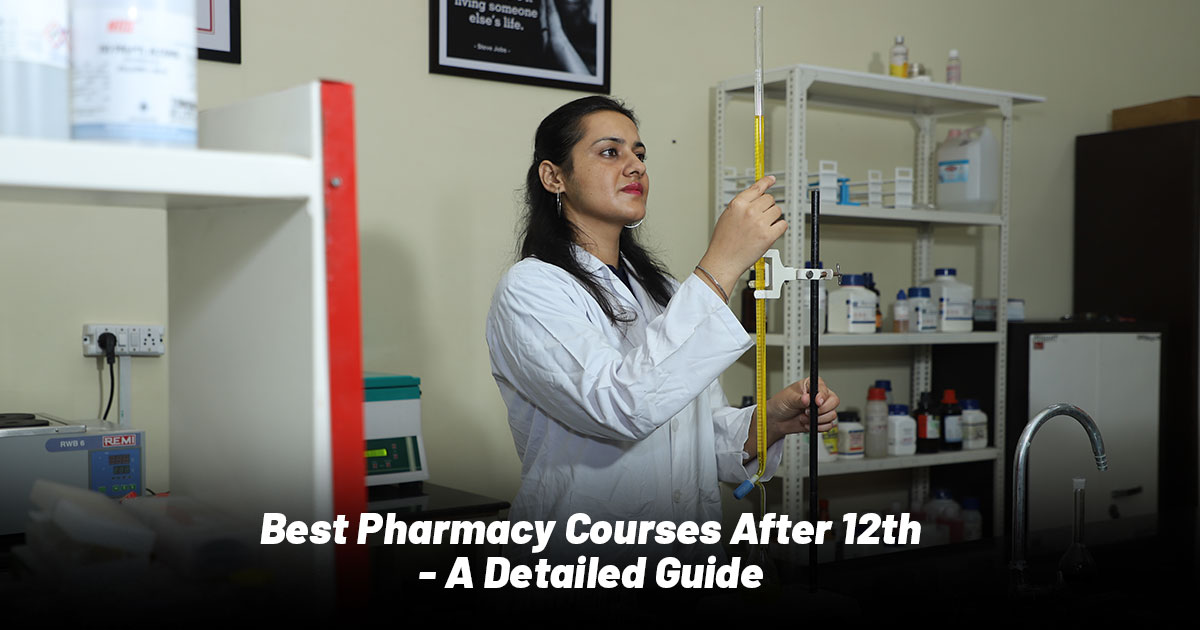
Best Pharmacy Courses After 12th in 2027 - A Detailed Guide
Pharmacy courses after 12th science are open to PCB and PCM students with a minimum of 50% marks in Class 12. The main courses are D.Pharm (2 years), B.Pharm (4 years), and Pharm.D (6 years). Each leads to different career paths: D.Pharm qualifies you for retail and hospital dispensing roles, B.Pharm opens production, quality, and research roles, and Pharm.D prepares you for clinical pharmacy practice. Starting salaries range from ₹2.5 to ₹6 LPA depending on the course and employer.
Three main entry-level paths exist: D.Pharm (2 years, diploma), B.Pharm (4 years, degree), and Pharm.D (6 years, doctorate-level clinical program).
Pharmacy courses after 12th do not require NEET for admission to most private universities. NEET is required only for government pharmacy colleges in states that mandate it.
Career roles include Pharmacist, Drug Inspector, Clinical Research Associate, Quality Control Analyst, Medical Representative, and Regulatory Affairs Officer.
Chandigarh University offers B.Pharm and Pharm.D programs through its University Institute of Pharma Sciences (UIPS), approved by the Pharmacy Council of India, with labs equipped with HPLC, FTIR, and UV Spectrophotometers.
India's pharmaceutical industry is projected to reach USD 130 billion by 2030, making pharmacy one of the most future-proof career choices for science students.
According to the Pharmacy Council of India (PCI), India had over 1.2 lakh registered pharmacists as of 2024, and the number of PCI-approved pharmacy institutions has grown by over 30% in the past decade, reflecting sustained demand for trained pharmacy professionals across hospitals, pharma companies, and research organizations.
Eligibility for Pharmacy Courses After 12th Science
Before you choose a course, confirm you meet the basic entry requirements.
Standard eligibility:
Completed Class 12 (10+2) from any recognized board.
Must have studied Physics and Chemistry as compulsory subjects, plus Biology or Mathematics.
Minimum 50% aggregate marks in qualifying subjects (45% for reserved categories at most institutions).
Minimum age of 17 years at the time of admission.
PCM students are eligible for most pharmacy programs since Physics and Chemistry are the core requirements.
Admission routes:
Direct merit-based admission at private universities.
State-level pharmacy entrance exams (MHT-CET, AP EAMCET, WBJEE).
University entrance exams, such as CUCET at Chandigarh University.
All Pharmacy Courses After 12th: Complete List
1. D.Pharm (Diploma in Pharmacy)
Detail
Information
Duration
2 Years
Eligibility
10+2 with PCB or PCM, Minimum 50% Marks
Admission
Direct Admission or State CET
Approved By
Pharmacy Council of India (PCI)
Core subjects:
Pharmaceutics
Pharmaceutical Chemistry
Pharmacognosy
Biochemistry and Clinical Pathology
Human Anatomy and Physiology
Health Education and Community Pharmacy
Practical applications: Students complete 500 hours of practical training in a hospital or retail pharmacy. After registration with the State Pharmacy Council, you are legally eligible to dispense medicines as a licensed pharmacist.
Best for: Students who want to enter the workforce quickly, open a pharmacy, or work in hospital dispensing. D.Pharm is the minimum qualification required to operate a licensed medical store in India.
2. B.Pharm (Bachelor of Pharmacy)
Detail
Information
Duration
4 Years (8 Semesters)
Eligibility
10+2 with PCB or PCM, Minimum 50% Marks
Admission
Direct Admission, CUCET, or State CET
Approved By
Pharmacy Council of India (PCI)
Core Subjects
Pharmaceutical Organic and Inorganic Chemistry
Pharmacology
Pharmaceutics (Dosage Form Design)
Pharmacognosy and Phytochemistry
Pharmaceutical Microbiology
Biopharmaceutics and Pharmacokinetics
Pharmaceutical Jurisprudence and Ethics
Industrial Pharmacy
Quality Assurance and Regulatory Affairs
Clinical Research Methodology
B.Pharm is not a classroom-only degree. You spend time in labs every semester, working on drug formulation, pharmaceutical analysis, and microbiology. The equipment you use includes HPLC systems, UV-Vis spectrophotometers, and dissolution testing apparatus, the same tools you will encounter in industry. Most programs also send you for industrial training in your third year, usually at a pharmaceutical company or hospital pharmacy.
This course works best if you are aiming for roles in pharma production, quality control, regulatory affairs, or clinical research. It also sets you up well for postgraduate study, whether that is M.Pharm, an MBA in Pharma Management, or Pharm.D post-baccalaureate.
Chandigarh University's B.Pharm program is approved by the Pharmacy Council of India. The curriculum is designed to meet international pharmacy education standards, and the labs are equipped with HPLC, FTIR, and rotary vacuum evaporators. The university also has MoUs with over 525 foreign universities, which open up opportunities for student exchange and collaborative research if that interests you.
3. Pharm.D (Doctor of Pharmacy)
Detail
Information
Duration
6 Years (5 Years of Study + 1 Year Internship)
Eligibility
10+2 with PCB, Minimum 50% Marks
Admission
CUCET, State Entrance Exam, or Direct Admission
Approved By
Pharmacy Council of India (PCI)
Core Subjects
Human Anatomy, Physiology, and Health Education
Pharmaceutical Biochemistry
Pathophysiology
Pharmacotherapeutics (All Disease Categories)
Clinical Pharmacy Practice
Pharmacovigilance
Clinical Toxicology
Pharmacoepidemiology and Pharmacoeconomics
Hospital and Community Pharmacy
Practical applications: The Pharm. D. is a clinical program. From Year 3 onwards, students undergo clinical postings in hospitals, working directly with patients, physicians, and medical teams. The final year is a full-time residency in a hospital pharmacy setting. Pharm.D graduates are trained to counsel patients on drug use, monitor drug therapy outcomes, and detect adverse drug reactions.
Best for: Students who want to work in hospital clinical pharmacy, pursue a career in drug safety, or practice clinical pharmacy in the US or other countries where the Pharm.D is the standard qualification for advanced pharmacy practice.
Chandigarh University's Pharm.D program is conducted through UIPS with clinical rotations in affiliated teaching hospitals and faculty from universities in the UK, Japan, the USA, and Canada.
4. B.Pharm (Ayurveda)
Detail
Information
Duration
4 Years
Eligibility
10+2 with PCB, Minimum 50% Marks
Admission
State CET or Direct Admission
Approved By
Central Council of Indian Medicine (CCIM)
Combines conventional pharmacy with Ayurvedic medicine. Core subjects include Ayurvedic Pharmaceutics, Dravyaguna (Ayurvedic pharmacology), classical formulations, and herbal drug technology. Graduates work in Ayurvedic pharma companies, wellness brands, and government AYUSH programs.
5. Diploma in Pharmaceutical Management
Detail
Information
Duration
1–2 Years
Eligibility
10+2 (Any Stream) or B.Pharm
Admission
Direct Admission
Covers pharma marketing, sales management, healthcare operations, and supply chain management. Suited for students targeting medical representative or pharma sales roles.
Pharmacy Courses After 12th: Salary and Career Scope
India's pharmaceutical industry is one of the largest in the world. According to the IBEF India Pharmaceuticals Industry Report (2025), India ranks third globally in pharmaceutical production volume and is projected to reach USD 130 billion by 2030.
Salary by role (2025):
Role
Course Required
Starting Salary
Retail Pharmacist
D.Pharm
₹2.5–₹3.5 LPA
Medical Representative
D.Pharm or B.Pharm
₹3–₹5 LPA
Quality Control Analyst
B.Pharm
₹3–₹5 LPA
Regulatory Affairs Officer
B.Pharm
₹3.5–₹6 LPA
Clinical Research Associate
B.Pharm or Pharm.D
₹4–₹7 LPA
Drug Inspector (Government)
B.Pharm
₹4.5–₹7 LPA (Plus Allowances)
Clinical Pharmacist
Pharm.D
₹4–₹8 LPA
Top recruiters: Sun Pharma, Cipla, Dr. Reddy's Laboratories, Lupin, Zydus Lifesciences, Aurobindo Pharma, Mankind Pharma, Biocon, AIIMS hospitals, Apollo Hospitals, and Fortis Healthcare.
B.Pharm: 4 years, PCI-approved, with industrial training in semester 7 or 8.
Pharm.D: 6 years, including 1-year hospital residency, PCI-approved.
Both programs are admitted through CUCET, with merit-based scholarships available. Labs include HPLC, FTIR, and UV Spectrophotometer facilities. The department places students across pharma companies, hospitals, and research organizations.
FAQs
Do I need NEET for pharmacy courses after 12th?
Short answer: No, not for most private universities. NEET only becomes compulsory if you are applying to a government pharmacy college in a state that has specifically mandated it for D.Pharm and B.Pharm admissions. Since this varies by state, it is worth checking the rules in the state where you plan to apply. At Chandigarh University, pharmacy admissions go through CUCET, not NEET.
What is the difference between D.Pharm and B.Pharm?
D.Pharm is a two-year diploma. It gets you registered as a licensed pharmacist and qualifies you to work in retail pharmacies or hospital dispensing. B.Pharm is a four-year degree that takes you further. It opens doors in pharma production, quality control, regulatory affairs, and research. It also makes you eligible for the GPAT, the entrance exam for M.Pharm at top institutions. If you have any interest in postgraduate study or a research career, B.Pharm is where you should start.
What is the scope of Pharm.D in India compared to B.Pharm?
They lead to different careers, so the comparison depends on what you want to do. The Pharm. D. is a clinical degree. It trains you for hospital pharmacy, patient counseling, and drug safety roles. If you want to practice clinical pharmacy in India or abroad, particularly in countries like the US, where Pharm.D is the standard qualification, it is the stronger path. B.Pharm, on the other hand, offers more options in the Indian pharma industry, spanning production, quality, marketing, and regulatory work. Most people who go the B.Pharm route follow it with an M.Pharm or an MBA to move into senior roles.
Step into a future full of possibilities with Chandigarh University!
B.Com Llb Vs Ba Llb Which Course Is Better After 12th
Explore key details about B.Com Llb Vs Ba Llb Which Course Is Better After 12th, including important information, opportunities, and insights for students.