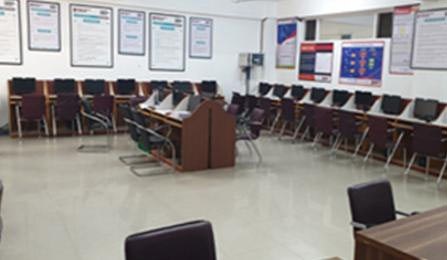
Chandigarh University houses various multifaceted Industry Sponsored Labs that gives our students an exclusive opportunity to learn on industry tools. It bridges the gap between Academia and Industry and enriches the real-time temperament of the students.
Equipped with state-of-the-art hardware and software tools, the lab provides students with hands-on experience in designing, developing, and testing embedded systems for a variety of applications, ranging from automotive electronics to IoT devices. Through this collaboration, students gain exposure to industry-relevant projects, enabling them to apply theoretical knowledge to real-world scenarios and hone their problem-solving skills. Moreover, the collaboration facilitates knowledge exchange between academia and industry, with experts from KPIT regularly conducting workshops, seminars, and training sessions in the lab.
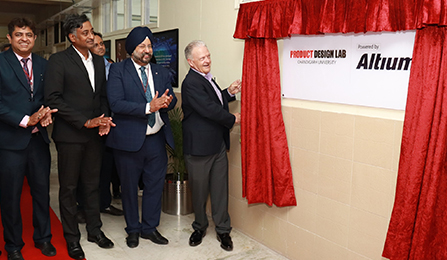
The Product Design Laboratory of the Department of Electronics &
Communication Engineering, established in collaboration with
ALTIUM, provides students with advanced facilities for
end-to-end electronic product development. The lab offers access
to PCB design resources created and owned by Altium, along with
industry-standard tools such as Altium Designer Pro and Altium
365 for seamless design, collaboration, and version control.
Students benefit from instructor-led workshops conducted by
the Altium Technical Team, enabling hands-on learning aligned
with global industry practices. The laboratory also supports
sponsored certification programs and provides 24×7 technical
assistance from the Altium Education Team. To strengthen
practical exposure, the lab is equipped with a MITS Eleven Lab
PCB Prototyping Machine for in-house PCB printing and a 3D
printing facility for rapid product prototyping. This
comprehensive ecosystem empowers students to transform
innovative ideas into functional, market-ready electronic
products.
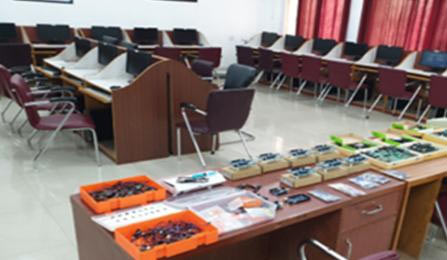
The Embedded Systems Laboratory of the Department of Electronics
& Communication Engineering, powered by KPIT, is designed to
provide students with strong practical exposure to modern
embedded technologies. The laboratory offers hands-on access to
the STM32F446RE development board, enabling students to design,
develop, and test real-world embedded applications. Learners
work extensively with industry-standard tools such as STM32Cube
IDE and STM32CubeMX for configuration, coding, and debugging of
embedded systems.
To strengthen programming fundamentals, the lab emphasizes
Embedded C skill development through PIC and ARM-based
programming. Students are also provided access to essential
LinkedIn Learning courses in C programming, supporting
self-paced learning and industry readiness. The laboratory
focuses on project-based learning, allowing students to
implement real-time applications and gain practical experience
aligned with current industrial practices. This comprehensive
setup ensures students are well-prepared for careers in embedded
systems and related domains.
This Labs provides a platform to inculcate the basic concepts and master the skills required for Robotics Process Automation, Embedded C, Sensor Interfacing, Artificial Intelligence and Machine learning, etc by introducing the multiple courses throughout the degree program. Students master these skills and realize their own innovations as well as solutions for user defined problems by integrating all technologies on a common platform.
This Lab provides the students with the fundamental treatment of
many practical and theoretical concepts that form the basis of
wireless communications and signal processing. It is intended to
equip the students with various kinds of wireless networks and
their operations and provide an analytical perspective on the
design and analysis of the traditional and emerging wireless
networks using a live simulation environment to provide Hands on
experience of latest technologies like, RF optimization, Network
planning, EMF Transmission, Broadband (Wi-Fi and DSL), FTTH,
WBB, GSM and CDMA etc.
To provide practical exposure of Cellular communication systems
between Mobile System and Base Transceiver Station. Following
facilities are available in the lab: Base Transceiver Station
(BTS), Modems, Cables, Connectors, different BTS antennas
(Sectored and Parabolic antennas), GSM mobile Trainer, Zigbee;
Bluetooth; Broadband Communication Kits.
This Lab also inculcates the concepts of Optical Fibre
Communication with hands-on experience on tools like- Qualnet,
OptiSim and hardware Fibre Splicer Kit.
In Electronics Hardware Labs students master the basic and
advanced skills related to Analog/Digital Hardware Design,
Electronics Devices & Circuits, Networks,
Microprocessor/Microcontroller based designs, Electromagnetics,
Microwave, Antenna, RF Tx and Rx, etc.
These laboratories are designed to make students understand:
a) the phenomenon of generation of microwave frequency using
various microwave tubes. It will inculcate the knowledge and
measurement techniques for various microwave
parameters/components. Further, the students will be able to
analyze and measure various parameters of microwave components
and apply them practically in real world applications.
b) the basic building blocks of linear integrated circuits. The
students will be able to apply the knowledge of electronics
engineering fundamentals to comprehend linear integrated
circuit-based systems. The students will study the concept of
waveform generation and some special function IC’s.
In this lab students apply the concepts of basic combinational logic circuits, sequential circuit elements, and programmable logic in the laboratory, to develop familiarity and confidence with designing, building and testing digital circuits including the use of EDA tools. Students master the Circuit level VLSI design using EDA tools and layout design.
The purpose of this course is to familiarize scholars with in-depth knowledge of applying new techniques, skills, and concepts in various real time applications of the electronics field. This course has a broad coverage in the field that is relevant for engineers to design and build circuits/applications using electronic components and motivate them for the interdisciplinary work. Students can realize their innovations, product prototypes, patents by utilizing the available lab resources.
In Programming and Simulation Lab students master the basic and advanced skills related to the latest programming languages which are currently in demand in the industry. This lab helps the students to interconnect Academica and Industry and prepares them for future assignments.
Stay Fearless And Get Ready To Conquer Your Coursework. According to the U.S Bureau of Labor Statistics, the total employment is projected to grow by 165.4 million over the 2020–30 decade, which means an increase of 11.9 million jobs.